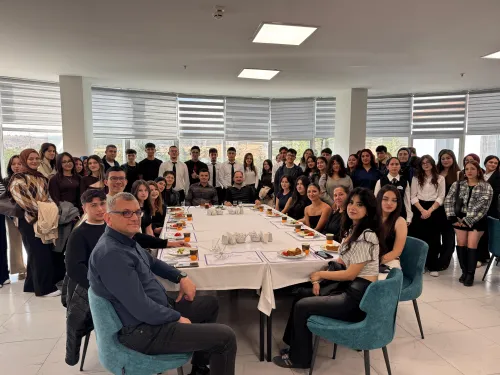

Our Vocational School organized the "Workshop on Identifying Tourism Problems and Solution Proposals" at Lavanta Tepesi Hotel in Salda.
Yapılış Tarihi | 26 October 2023, Thursday

The "Tourism Problems Identification and Solution Proposals Workshop" organized by the Burdur Governorship in cooperation with the Burdur Provincial Directorate of Culture and Tourism and Burdur Mehmet Akif Ersoy University (MAKÜ) was held at Yeşilova İsmail Akın Tourism Vocational School Salda Lavender Hill Hotel.

Burdur Governor Türker Öksüz, Burdur Deputies Prof. Dr. Adem Korkmaz, İzzet Akbulut, Burdur Mayor Ali Orkun Ercengiz, MAKÜ Rector Prof. Dr. Hüseyin Dalgar, Burdur Provincial Director of Culture and Tourism İbrahim Emre Gürsoy, district governors and mayors, provincial directors, academicians and experts from the tourism sector attended the workshop where Burdur's tourism potential and solution proposals were discussed.
The opening speech was made by Burdur Provincial Director of Culture and Tourism İbrahim Emre Gürsoy. In his speech, Gürsoy stated that Burdur has tourism potential but needs to be promoted, that the workshop is important for Burdur tourism, and that he believes the results of the workshop will lead to significant projects. Continuing his speech, Director Gürsoy said, "We think it is time for the sleeping beauty to wake up, comb her hair, and show herself. In this context, we are doing our best as the provincial directorate under the leadership of our governorship."

Then, Prof. Dr. Muharrem Tuna, a faculty member at Ankara Hacı Bayram Veli University and President of the Association of Tourism Academicians, also gave a speech. Prof. Dr. Tuna stated that Burdur tourism has significant appeal, that Burdur has geographical potential, and that the topics to be addressed in this workshop in the fields of eco-tourism, gastronomy, culture, and tourism will bring Burdur's tourism potential to better points. He continued his speech as follows: "The tourism sector makes significant contributions to national income, employment, and the welfare of the region. In 2019, 1.5 billion people participated in international travel worldwide. These 1.5 billion people spent 1.7 trillion dollars. When we look at the volume of this expenditure, it is seen that tourism has a very high appeal both in terms of countries and more micro-scale destinations, provinces, and districts. Primarily, the local people benefit significantly from this. Economic contributions are made, infrastructure is built, and superstructure is built. These do not only serve tourists. With the resources allocated as a result of the plans made, the happiness and welfare of the local people also increase. The tourism sector supports more than 50 sectors. It takes inputs from these sectors and makes significant contributions to both strengthening employment and enriching the people in those areas. Our Rector is here among us, and it is very important for all stakeholders to come together and make a serious move. I believe that Burdur will successfully achieve this. Among the most important prerequisites for the development of the project is qualified personnel in the region. Especially worldwide, not just for Turkey, human resources have started to emerge as a rising problem. Burdur is a lucky destination in this respect. Because there are very important schools both in the center of Burdur and in Yeşilova, where you are now. These schools especially carry out practical training. Look, there is a hotel upstairs. There is also a school downstairs, and an integrated process is working intertwined, which is very valuable in meeting the expectations of the sector. Especially these 6+2, 7+1 models are very widely accepted worldwide, meaning you provide education at school for a certain period, and you continue part of it within the industry sector. These practices are really accepted worldwide. I would like to congratulate Mehmet Akif Ersoy University for taking the initiative and starting these practices. With these thoughts, I wish the workshop to be beneficial to our province and our country."

Starting his speech with the words "Welcome to our unique school, which is unique to our university and has no equivalent in Turkey," Rector Prof. Dr. Hüseyin Dalgar continued his speech as follows: "This is an environment where students receive theoretical education in the morning, practice in these classrooms in the afternoon, and graduate with experience in a real application environment in the sector. Today we are talking about our tourism mission. I can say two things about tourism. It is important for us to train people who have gained skills in the sector, not just filled their minds with knowledge, but also gained practical skills. In this context, we are a university that has implemented unique applied education models that we can call the first in Turkey. We are implementing applied education models that are the first in Turkey and are also modeled by other universities, both in our tourism school on our campus and in our school here, so that our students do not experience problems with experience and practice when they join the business world. This is the 3+1 and 6+2 model you mentioned, meaning students who enter the hotel in the first year and enter the kitchen in the first year are subjected to a program within the application for 4 years. In this respect, Mehmet Akif Ersoy University makes a difference. We believe that this is our responsibility as scientists raised by the country. Therefore, I would like to clearly state here that we will definitely take an active part as a university in all projects related to the tourism field that will be carried out after this workshop. It is an important contribution to the sector that we have turned our school right next to Salda Lake, which is visited by nearly one million people a year, into such a unique model. The fact that this meeting is held here is also of particular importance to us. I would like to thank our governor, who led this workshop. We really want to identify the issues sector by sector in Burdur, produce solutions with common sense, and then all together pursue these solutions and contribute to the development of that area. I also thank all my colleagues and all the professors who contributed to the workshop on the university side."

Burdur Mayor Ali Orkun Ercengiz, who also gave a speech later, stated that this workshop is important for Burdur and said, "As Burdur, we need to look at where we can find our place within alternative tourism methods and how we can develop ourselves in this area and get a share of this pie. First of all, we should probably target day tourism and then diversify tourism and evaluate these topics in terms of alternative tourism methods such as gastronomy, sports tourism, or eco-tourism, and perhaps strengthen the investment in accommodation tourism. We need to look at how we can make Burdur more attractive for tourists coming to Antalya and bring Burdur tourism to the forefront."

In his speech, Burdur Deputy İzzet Akbulut said, "Since our governor took office and started working in harmony with MAKÜ and the 3 deputies, and since the province's bureaucracy started talking about what we can do by putting aside these political sterile discussions, I think we have made progress and I believe we can make even more progress. When we look at its potential, we have a city full of riches that cannot be underestimated in tourism. Burdur Lake and Salda Lake. I think there is a lack of brands in Burdur. I agree with our governor. As Burdur, we need more advertising to highlight Burdur's values. We need stories, and I think this workshop will lead the way. I thank all the stakeholders who contributed to this workshop."

Deputy Prof. Dr. Adem Korkmaz emphasized that Burdur has gained great recognition not only through agriculture and animal husbandry but also especially through Salda Lake and is visited by 1 million visitors annually. In his speech, where he stated that cooperation and correct investments are needed to further expand this potential, he said, "Yes, Burdur is now known and recognized not only for its presence or potentials in agriculture and animal husbandry but also in tourism, especially with Salda in recent years. It has reached an annual visitor capacity of 1 million people. If we find the right path in this flow, that is, if all the components, actors, managers, and tourism sector elements of Burdur come together, everything will be very different. Burdur's tourism is not only a matter of Burdur but also a matter of the Turkish tourism sector. When the Turkish tourism sector investor wants to expand this investment, one of the alternatives is now this region. When we talk about classic tourism behavior, there is a great tourism demand worldwide that goes beyond the trio of sand, sun, and sea that we know. In fact, this demand is for people who have much higher spending capabilities in terms of individual spending compared to the other. When you put history and nature next to this, a different tourism area emerges. Our tourism friends will probably explain this to us much better. The world mobility and country mobility routes also have much different routes compared to classic sea-based tourism. The touristic potential of this place has differences. It is necessary to work accordingly. We need to create a strong roadmap with these workshops, and this roadmap needs to be integrated. That is, every step we take must have a connection with the next step and the subsequent steps and results. Our university has a tourism vision that it put forward in previous years, about 7-8 years ago. We have a thematic strength in sports tourism, which is a sub-area of this. Let me put it this way, the stone we threw in this area is now on the verge of creating a big wave. We have great potentials, but infrastructure, facility construction, and the completion of other complementary tourism services are necessary. Some of this needs to be completed by the private sector and some by public infrastructure investments. I know and hope that all of these will be discussed in this workshop and that a roadmap will be drawn for us."

Finally, Burdur Governor Türker Öksüz made a speech. Governor Öksüz summarized his speech as follows: "Since the second half of the 20th century, the "Tourism Sector" has been one of the fastest-growing and developing sectors in the world economy. The tourism sector, which provides employment to more than 250 million people worldwide, is one of the largest sectors in the world and gives a strong impetus to global economic development. The situation of the tourism sector, which is growing so rapidly in the world, is also developing in Turkey almost parallel to the trends in the world. Burdur is the meeting point of beauties with its friendly, warm, and hospitable people, historical accumulation, lakes, and plateaus. Being at the crossroads of roads as well as at the crossroads of civilizations has made Burdur rich in cultural and historical aspects. Our province was called "Pisidia" in the Ancient period, "Lakes Region" geographically, and "Teke Region" culturally. Burdur is the cultural capital of the region known as the Teke Region. Reflecting the characteristic features of the Lakes Region and the historical diversity of Anatolia in the best way, Burdur is in a complementary position to Antalya in the fields of eco-tourism, cultural tourism, and tourism-oriented sports activities. Burdur is a cheap, quiet, and safe city with its historical/touristic places, ancient cities, eco-tourism opportunities, caravanserais, mansions, lakes, plateaus. Burdur, which stands out with its thousands of years of historical and cultural assets, has many ancient cities such as Sagalassos, Kibyra, Kremna, inns from the Seljuk period, the most magnificent mansions of the Ottoman period, museums and ruins where magnificent historical artifacts are exhibited, oxygen-rich green mountains, cool plateaus, caves, blue lakes and dams such as Burdur, Salda, Yarışlı, Karacaören lakes, purple and fragrant lavender gardens, rich flora and fauna, wide eco-tourism and nature sports areas, restaurants offering local dishes, traditional handicrafts, in short, Burdur, which has environments where